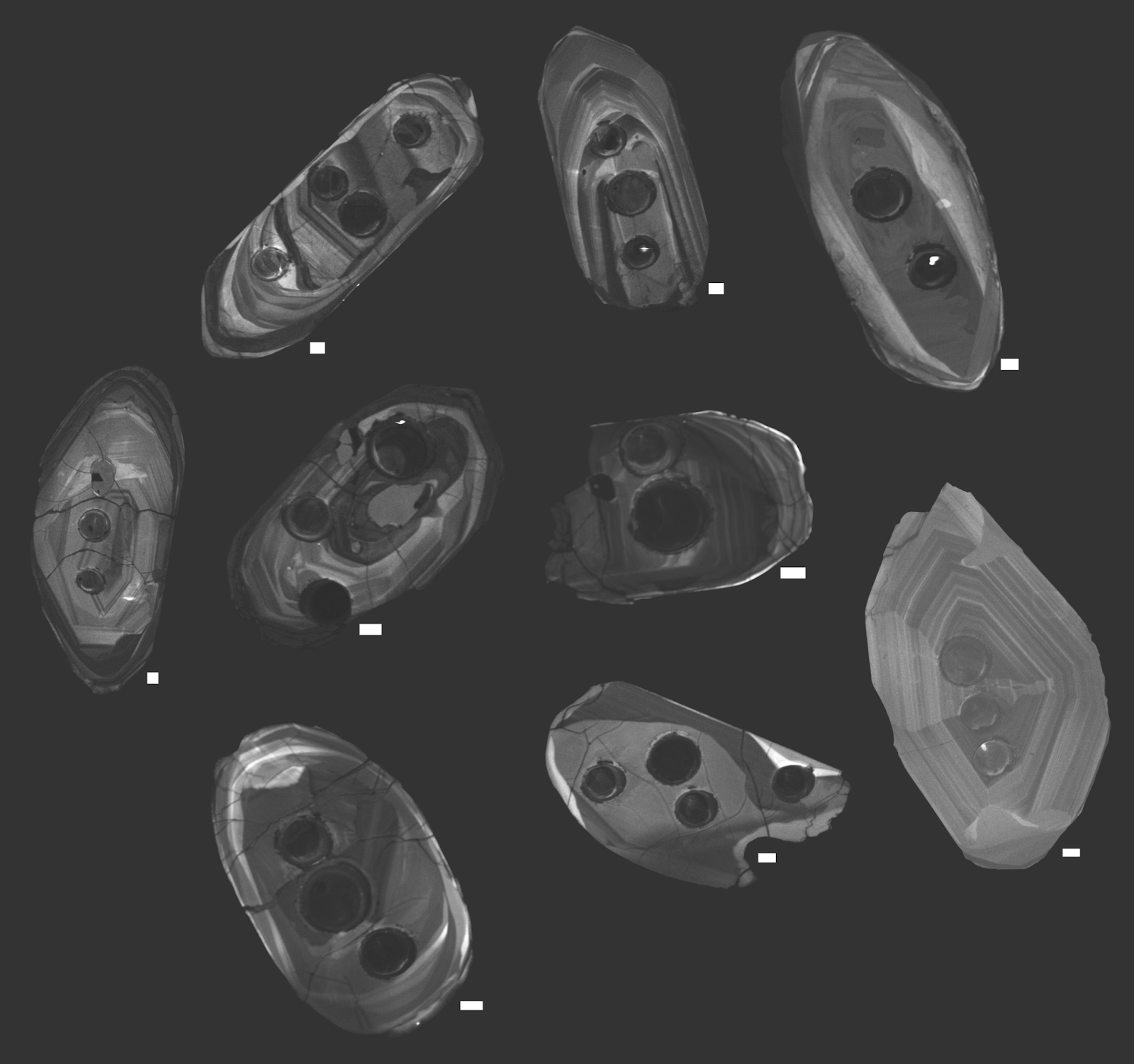
原文網址:https://phys.org/news/2025-07-geologists-early-continents-mantle-plumes.html
近日香港大學的地質學家對於25億多年前稱為太古宙的遠古時期當中,地球的早期陸地是如何形成的這道問題有了新的進展。他們發表在《科學前緣》(Science Advances)的發現提出早期的大陸地殼可能是由發生在地球深處,稱為地函柱的作用所形成,而非今日塑造陸地的板塊構造作用。
原文網址:https://phys.org/news/2025-07-geologists-early-continents-mantle-plumes.html
近日香港大學的地質學家對於25億多年前稱為太古宙的遠古時期當中,地球的早期陸地是如何形成的這道問題有了新的進展。他們發表在《科學前緣》(Science Advances)的發現提出早期的大陸地殼可能是由發生在地球深處,稱為地函柱的作用所形成,而非今日塑造陸地的板塊構造作用。
原文網址:https://cmns.umd.edu/news-events/news/researchers-solve-one-earths-ancient-volcanic-mysteries
新研究追查距今1億2000萬年前發生的「超級火山爆發」其源頭為何,結果讓我們對於地球複雜的地質歷史有了新的觀點。
由馬里蘭大學與夏威夷大學領導的地質學家團隊串連了逐條線索,終於找出地球歷史上規模最大的火山噴發之一其源頭來自太平洋的深處。

Val Finlayson (左)與Paulo Galvan在2013年的研究航次中從深海取得的岩石樣品。 圖片來源:Val Finlayson.
By Daniel Strain
根據科羅拉多大學波德分校的科學家發表的新研究,大約在距今10000年前末次冰期即將落幕之際,北美大陸的漂移速度以及大西洋的擴張速度可能曾經短暫提升——而融化的冰河在這其中助了一臂之力。

地球表面之下的騷動或許讓人覺得像是另一個世界發生的事情,但這些活動卻可以幫助陸塊形成,進而決定海洋環流、氣候模式,甚至是動物的行動與演化。事實上,科學家相信數百萬年前一道從地函往上湧的高溫岩石柱,可能在人類的演化史中具有重要的地位。

一群正在渡河的大象,攝於波札那的喬貝國家公園。圖片來源:Getty Images
南安普敦大學的科學家解開了關於板塊運動的一大謎題:為什麼某些陸地的「穩定」部分可以逐漸抬升成地球最雄偉的地形特徵?又是透過什麼樣的作用?
.jpg)
從Sentinel Hub Earth Observation Browser下載非洲南部大斷崖的衛星影像。該影像取自哨兵2號(Sentinel-2)的L1C資料庫。圖片來源: Tom Gernon教授,南安普敦大學。
by Matthew
Carroll
一類古老、遼闊、稱為穩定地塊的大陸地殼幫助地球的陸地數十億年來,即便經歷了陸塊漂移、山脈隆起與海洋形成等作用,仍然處在相當穩定的狀態。距今大約30億年前穩定地塊是透過什麼作用形成,在地球歷史的相關研究中是個歷時已久的問題。最近賓州州立大學的科學家提出的新機制或許能夠加以解釋。

這些稱作片麻岩的古老變質岩發現於北極海海岸。現今出露在地表的這些岩石,過去曾是陸地的根部。科學家表示穿插在這類岩石當中的沉積岩,就像熱機一樣具有讓陸地穩定下來的功能。圖片來源:Jesse Reimink
原文網址:https://phys.org/news/2023-09-plate-tectonics-billion-years-life.html
by Hannah Bird ,
Phys.org
地球表層形成陸地的部分,或稱作地殼,最初大約是在40億年前形成,成分為25-50公里厚的玄武岩(一種火山岩)。科學家原先認為當時是由一塊完整的岩石圈地殼將整個地球包覆起來;相較之下我們今日所見各自分離的板塊,一般相信還要再過10億年才開始形成。然而,現在有越來越多科學家對此假說抱持質疑的態度。

史太古代的大陸地殼可能的形成機制:(a)重力沉降(重力造成密度較高的地殼沉入地函);(b) 大陸地殼在聚合性板塊邊界層層堆疊,但密度仍低於下方的地函。(c)在聚合性板塊邊界發生的淺層隱沒作用。此研究支持模型b與c。圖片來源:Hastie et al., 2023與Nutman, 2023。
科學家運用歐洲同步輻射裝置(ESRF)的ID21光束線,研究古代岩漿裡的鋯石晶體所含有的磷灰石包裹體,結果揭曉了關於大氧化事件的重要訊息。這項成果發表於《自然—地球科學》(Nature Geosciences)。

用ESRF的ID21光束線測量鋯石內部的磷灰石包裹體的硫物種。大氧化事件前後,硫的能譜從還原硫(S2-)轉變成氧化硫(S6+)。作者主張原因為被空氣置換過的沉積物滲入地函,使得岩漿的氧化還原狀態有所改變。圖片來源:ESRF
原文網址:https://news.illinois.edu/view/6367/1692853846
By Lois
Yoksoulian
伊利諾大學厄巴納—香檳分校的新研究指出,地球大陸板塊內部年代久遠、看似穩定的區域(稱為「穩定地塊」)在形成之後,地殼以下的部分曾經反覆受到變形作用。這道假說不只否定了數十年來板塊構造理論的傳統看法,也有望回答為什麼穩定地塊大部分區域在構造上都保持穩定的同時,底部卻經歷過劇烈變化的問題。

這張假想的橫剖面顯示了羅迪尼亞超大陸分裂時的地殼與地函,一道上湧的地函柱引發了下部地函的脫落作用。圖片來源:Lijun Liu
Lindsey Valich
鋯石晶體與岩漿為地球數十億年前的板塊構造活動提供了新的資訊。

板塊構造作用透過融化與混和不同岩石來創造出具有特定化學組成的岩漿。羅徹斯特大學的地質學家利用這類化學證據,解出關於40多億年前地球的板塊構造活動資訊。(Getty Images photo)
原文網址:https://news.ucr.edu/articles/2022/08/17/sleeping-giant-could-end-deep-ocean-life
陸地移動可以剝奪海洋裡的氧氣
By Jules
Bernstein
在促使地球海洋充滿生命所需的氧氣這方面,有一項因素之前並未受到重視:陸地的位置。但陸地移動也能導致相反的效果,殺死海洋裡絕大部分的生物。

在阿拉斯加發現的深海水母。圖片來源:Hidden Ocean 2005
原文網址:https://www.southampton.ac.uk/news/2022/06/ancient-warming.page
南安普敦大學的科學家發現地球歷史上最嚴重且最急遽的全球暖化時期之一,可能是由陸地伸張所造成。

法羅群島的假色衛星影像。圖片來源:Sentinel
Hub EO/T Gernon
南安普敦大學的研究人員和愛丁堡大學、里茲大學、奧爾登堡大學、佛羅倫斯大學、中國科學院的同仁合作之下,探討了5600萬年前一段極端的環境變遷事件中,全球構造作用力以及火山爆發造成的影響。
在這段時期一連串的事件造成地球暖化了5-8
˚C,其間的高峰稱為「古新世-始新世氣候最暖期」(PETM),持續了大約17萬年。許多深海生物因而滅亡,也重塑了地球生物的演化方向。
大陸板塊就像太妃糖可以越拉越細、最後斷掉一樣,團隊提出北半球的大陸板塊當時經歷了大幅度的伸張,使得地球深處的壓力大幅減弱。這促成地函,也就是緊鄰地殼下方黏稠、熔化的岩石發生了短暫卻強烈的熔化作用。團隊指出其造成火山活動的同時,也發生了和PETM暖化事件有關的現象——許多碳突然釋放到大氣當中,火山活動有可能就是這些碳的來源。
研究人員的發現發表在期刊《自然—地球科學》。
PETM暖化事件的速度和規模都相當快,因此在瞭解現下的全球暖化時經常用PETM當作過去的類比,即使兩者的機制完全不同。
「儘管PETM在研究當今的全球變遷非常重要而且用途廣泛,但是其背後的原因還是頗有爭議,」研究主要作者,南安普敦大學地球科學系的副教授Tom
Gernon表示。「科學家一般同意從地球內部突然釋放出大量的溫室氣體,也就是碳,是這起事件的必要條件。但是常見的火山作用卻很難解釋暖化的規模與速度。」
團隊利用大西洋沿岸海底鑽出的岩石紀錄,發現的關鍵證據顯示曾經有一段遍布大西洋、快速發生且大範圍的火山活動期。它的持續時間剛好超過20萬年,與PETM的長度驚人地相似。
這項發現激起團隊從北大西洋地區往外延伸調查更大的範圍,包括格陵蘭和法羅群島。他們在這些地方發現了厚達一公里的熔岩,噴發時間在PETM不久之前。而且其不尋常的成分指出在這塊陸地下方,地函最上層的固體部分產生了比以往多出許多的熔融物質。
「這項發現相當重要,因為我們知道此區下方有部分的大陸地函富含碳酸鹽——它們可以產生很多碳,」Gernon博士解釋。「此區地函的熔融物質大量增加有可能讓非常大量的碳釋放出來,絕對高出我們之前的預估。」
格陵蘭和歐洲曾經是相連在一起的陸塊,它受到板塊作用力而強烈伸張的時候也造成了這場火山活動。最後北美和格陵蘭從歐洲分裂出去,大西洋也隨之誕生。科學家認為在伸張的最後階段引發了地函大量融化,使得非常多的碳釋放出來,因而造成全球暖化。
團隊利用不同的模型來預估該作用可以釋放多少碳。「我們從物理上實際預估這些火山系統的關鍵特性,得出驅動暖化所需的碳可以藉由熔融增加來達成,」研究共同作者,南安普敦大學的高級研究員Thea
Hincks表示。
PETM這類急遽暖化的事件在地球歷史上很可能發生過許多次,科學家的結論認為從固體地球迅速釋放出來的碳在過程中扮演了關鍵腳色。「這種迅速發生的事件從基本層面上重新建構了地表環境,改變了許多生態系,」Gernon博士總結。
Stretching of the continents drove
ancient global warming event, say scientists
Scientists at the University of
Southampton have discovered that stretching of the continents is likely to have
caused one of the most extreme and abrupt episodes of global warming in Earth
history.
The researchers, working with colleagues at the
University of Edinburgh, the University of Leeds, the University of Oldenburg,
the University of Florence and the Chinese Academy of Sciences, studied the
effects of global tectonic forces and volcanic eruptions during a period of
extreme environmental change 56 million years ago.
During this time, some sequence of events caused the
planet to warm by 5-8˚C, culminating in the ‘Palaeocene-Eocene Thermal Maximum’
or PETM, which lasted about 170,000 years. This caused the extinction of many
deep-sea organisms, reshaping the course of evolution of life on Earth.
The team propose that the extensive stretching of the
continental plates in the northern hemisphere – rather like the pulling of a
toffee bar that thins and eventually separates – massively reduced the
pressures in the Earth’s deep interior. This then drove intense, but
short-lived melting in the mantle – a layer of sticky, molten rock just below
the planet’s crust. The team show that the resulting volcanic activity
coincided with, and likely caused, a massive burst of carbon release into the
atmosphere linked to PETM warming.
The researchers’ findings are published in the
journal Nature Geoscience.
The great speed and magnitude of warming mean that
the PETM event is often considered as an ancient analogue for understanding
present-day warming, even though the mechanism is completely different.
“Despite the importance and wider relevance of the
PETM to global change today, the underlying cause is highly debated” says Dr
Tom Gernon, an Associate Professor of Earth Science at the University of
Southampton and lead author of the study. “It’s generally agreed that a sudden
and massive release of the greenhouse gas, carbon, from the Earth’s interior
must have driven this event, yet the scale and pace of warming is very hard to
explain by conventional volcanic processes.”
Using archives of rock drilled beneath the seafloor
near the edge of the Atlantic Ocean, the team found critical evidence for an
abrupt and widespread episode of volcanic activity across the North Atlantic
Ocean that lasted just over 200,000 years, strikingly similar to the duration
of the PETM.
This finding prompted the team to investigate a
broader expanse of the North Atlantic region, including Greenland and the Faroe
Islands. Here, they found that kilometre-thick piles of lava that started to
erupt just before the PETM show unusual compositions that point to a
significant increase in the amount of melting of the uppermost solid part of
Earth’s mantle beneath the continent.
“This finding is significant, because we know that
parts of the continental mantle in this region are enriched in carbonates, a
major source of carbon”, explains Dr Gernon. “This rapid increase in mantle
melting likely released a very large volume of carbon – certainly more than we
had previously expected”.
The intense volcanic activity occurred just as the
continental landmass that united Greenland and Europe was most intensely
stretched by plate tectonic forces. Eventually, North America and Greenland
finally separated from Europe, leading to the birth of the North Atlantic
Ocean. The scientists believe it was this final phase of stretching that
brought about substantial melting in the Earth’s mantle, leading to massive
carbon release, and in-turn, global warming.
The team used a range of different models to estimate
how much carbon could have been released via this process. “Using physically
realistic estimates of the key characteristics of these volcanic systems, we
show that the amount of carbon needed to drive warming could have been attained
by enhanced melting” says Dr Thea Hincks, Senior Research Fellow at the
University of Southampton and co-author on the study.
The scientists conclude that rapid gas release from
the solid Earth plays a major role in driving abrupt warming events like the
PETM, which are very likely to have occurred during many other times in Earth
history. “Such rapid events cause a fundamental reorganization of Earth’s
surface environment, altering vast ecosystems”, concludes Dr Gernon.
原始論文:Gernon, T.M.,
Barr, R., Fitton, J.G. et al. Transient mobilization of subcrustal
carbon coincident with Palaeocene–Eocene Thermal Maximum. Nat.
Geosci, 2022 DOI: 10.1038/s41561-022-00967-6
引用自:University of Southampton. "Stretching of
the continents drove ancient global warming event, say scientists."
By Crispin Savage
呈現出陸地如何拚合的新模型對於地球歷史提供了全新觀點,也有助於我們更加瞭解地震與火山這類自然災害。

新的板塊模型,板塊間的交界帶有特別加深。圖片來源:Derrick Hasterok博士,阿德雷德大學
原文網址:https://ethz.ch/en/news-and-events/eth-news/news/2021/11/crushed-resistance.html
By Peter
Rüegg
地球物理學家利用新的模型來解釋隱沒帶的板塊沉入地函過程中的行為:板塊底部的礦物顆粒體積變小,使得板塊強度變弱,因此更容易變形。

模型對於日本下方的隱沒板塊為何會分段提出了新觀點:板塊底部彎曲造成橄欖石晶體被壓碎。(圖片來源:Taras Gerya / ETH Zurich)
從澳洲西部傑克丘找到的古老鋯石,精準定出讓地球適合生命居住的重要事件發生在什麼時候
史密森尼美國國立自然史博物館的地質學家Michael Ackerson領導的科學團隊提出的新證據,顯示目前的板塊運動類型――這項讓地球能養育生命的關鍵特徵大約是出現在36億年前。
鋯石顆粒。圖片來源:Michael Ackerson,史密森尼基金會